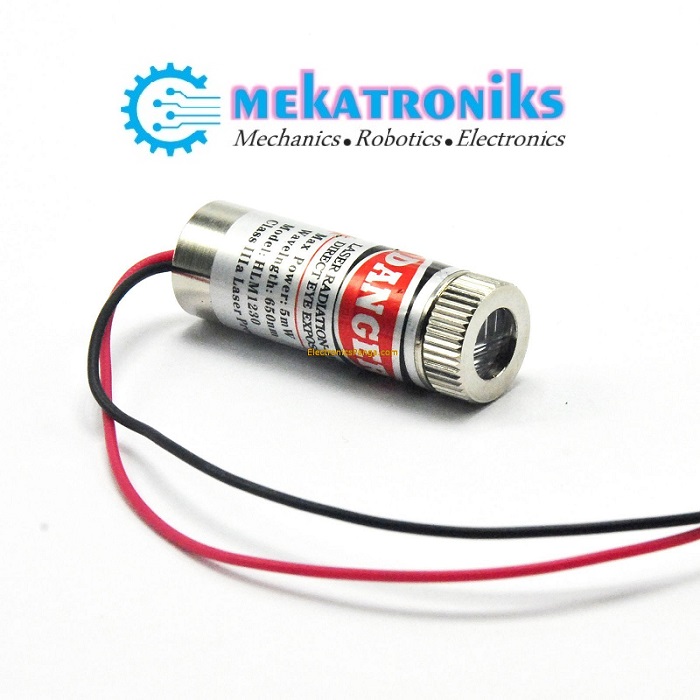
Laser Module Red Dot Description: Laser Module Red Dot 5mW 650nm Adjustable Focusable 3-5V Dc in Pakistan, laser diode is an industrial electronic component Output Power=(mW): <5 Wave length=(nm): 650 Voltage: 3~5V Current: ≤45mA Temperature: 15 ℃~+35 ℃ Life Span: 10000 hrs Laser Shape: Dot Focusable: Yes Material and Color: Metal Plastic Lens Dimensions: 12*35mm Feature: Red wire “ ” pole; black wire “-” pole. This 650nm laser diode is an industrial electronic component and used for as Industrial testament, Lab, DIY. It is precise and sensitive optical instrument. Care Instruction: Please keep the lens clean to make the laser beam clear and bright. Before carrying on some laser DIY activities, please read about the technical information first and protect your eyes before laser ray. Be sure the operator has experience in optics DIY or testing Laser Module Red Dot Features: Wavelength:650nm Output Power:5mw Working Voltage:3 – 5V Laser Shape: dot Material and Color: Metal Red wire “ ” pole; black wire “-” pole. This 650nm laser diode is an industrial electronic component and used for as Industrial testament, Lab, DIY. It is precise and sensitive optical instrument. Care Instruction: Please keep the lens clean to make the laser beam clear and bright. Before carrying on some laser DIY activities, please read about the technical information first and protect your eyes before laser ray. Be sure the operator has experience in optics DIY or testing. Laser diodes form a subset of the larger classification of semiconductor p–n junction diodes. Forward electrical bias across the laser diode causes the two species of charge carrier – holes and electrons – to be “injected” from opposite sides of the p–n junction into the depletion region. Holes are injected from the p-doped into the n-doped, and electrons vice versa, semiconductor The active region of the laser diode is in the intrinsic (I) region, and the carriers (electrons and holes) are pumped into that region from the N and P regions respectively en.wikipedia.org